
The full recipe · Neapolitan
Neapolitan pizza dough: my complete recipe
Mix strong flour with 60% water, 2% salt and 0.15% fresh yeast in the evening, divide the dough into 270 g balls and put them straight into dough boxes. Let them rise overnight at room temperature for 12 to 14 hours until they have grown by about half, then put the whole box in the fridge. Take it out 3 hours before baking, stretch the balls by hand and bake them as hot as your oven goes.

- Water
- 60%
- Salt
- 2%
- Fresh yeast
- 0.15%
- Per ball
- 270 g
- Mix to pizza
- about 24 h
How it works: a day in the life of a dough ball
Example: pizza tomorrow at 8 pm. The dough does almost everything on its own; you step in four times.
-
8 pm
Mix
Flour, water, salt and yeast, about 5 minutes by hand
-
Right after
Balls into the box
270 g each, lid on
-
Overnight
Let them rise
12–14 hours at room temperature, until they have grown by about half
-
In the morning
Into the fridge
the whole box. A pause until the evening, and longer is fine too
-
5 pm
Out of the fridge
let them relax for 3 hours, then they stretch easily
-
8 pm
Stretch, top, bake
into the oven in under 60 seconds, as hot as it goes
The ripeness check in the morning
This is how the balls in the box look from the side.
- Too earlywait a little longer
- Just right: +50%into the fridge
- Too farreshape, let them rise again
No dough boxes, or sourdough? The whole dough rises in one container, and you shape the balls 3 hours before baking. Short on time? 3% fresh yeast and 1% malt, and it works in one or two hours.
Ingredients
| Ingredient | Baker's % | Amount |
|---|---|---|
| Flour strong, with plenty of protein: check the pack, the more the better | 100% | 1,999 g |
| Water at room temperature | 60% | 1,200 g |
| Salt | 2% | 40 g |
| Fresh yeast too little for a kitchen scale: use a fine scale | 0.15% | 3 g |
Dry yeast works too: 1 g, a third of the fresh yeast.
Different size, hydration or sourdough? Open the calculatorWhat you need
- Kitchen scalefor the flour, the water, the salt and the dough balls
- Fine scaleweighs to 0.01 g, so the tiny amount of yeast is exact
- Dough boxes with a lidthe balls rise in them, and the whole box goes into the fridge
- Dough scraperkeeps the work surface clean, divides the dough and gets the balls out of the box
- Oven with a grill functionwith a pizza steel or stone. Alternatively a cast-iron pan for the stove, or a pizza oven
- Semolina and a pizza peelso the pizza slides into the oven
Step by step
-
Evening
Mix by hand for about 5 minutes
Put the flour, water, salt and yeast in a bowl and mix everything by hand for about 5 minutes. Don't knead hard: just mix until there is no dry flour and no lump left. Mixing by hand gives you a feel for the dough, which helps a lot at the start.
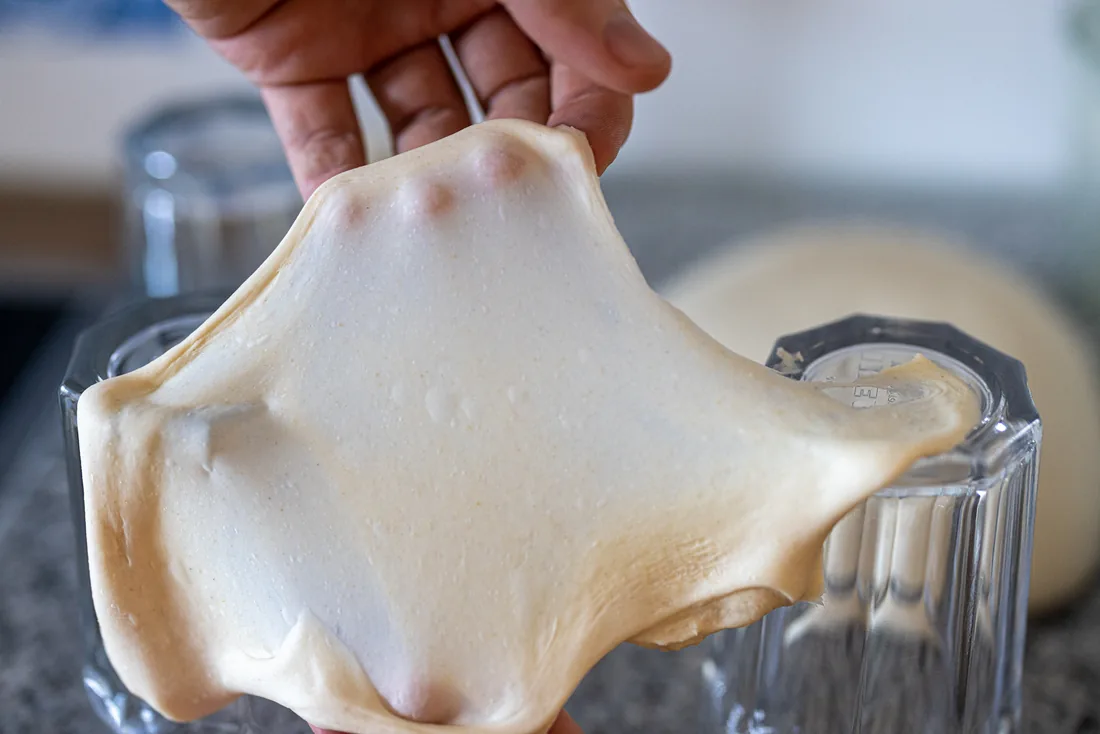
Then do the windowpane test: stretch a small piece so thin that light shines through it without tearing. If it holds, the dough is ready.
-
Right after mixing
Divide into balls straight away
Weigh pieces of 270 g and cut them off with the dough scraper. Shape each piece into a smooth ball by dragging it over the bare counter, without flour, so its surface tightens. Don't shape them too tight. Put the balls into the dough boxes and close the lid.
-
Overnight
Let them rise at room temperature
The boxes stay on the counter overnight. With this little yeast the balls need about 12 to 14 hours to grow by about half. The warmer your kitchen, the faster it goes: if it is warm, use slightly cooler water; below 20 °C, use twice the yeast.
-
In the morning
Grown by half? The whole box goes into the fridge
When the balls have grown by about 50%, put the whole box into the fridge. Left out, they would over-proof. In the fridge they wait for you until the evening, and at around 4 °C, after a while, nothing happens at all. So if your plans change, they simply stay in longer.
Did they go too far and spread out flat? With yeast that's no drama: shape them into balls again and let them rise once more.
-
3 hours before baking
Take the box out
Take the box out of the fridge 3 hours before you want to bake. The balls come up to room temperature and relax, and that makes them much easier to stretch.
-
Stretching
Stretch by hand, top quickly
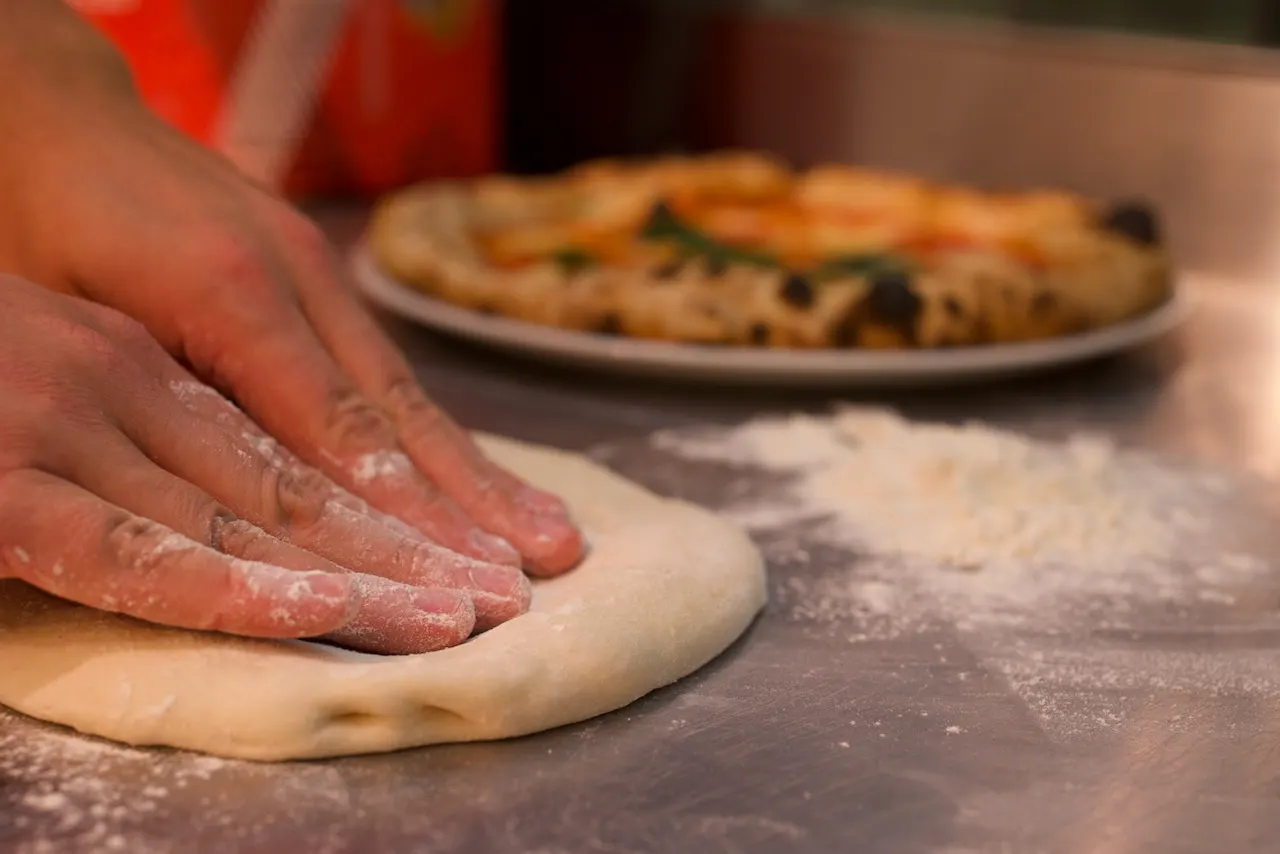
Put plenty of semolina on the work surface, so the pizza doesn't stick to the peel later. Lift a ball out of the box with the dough scraper and set it down in the semolina. Press it flat from the centre outwards and leave the edge alone: that pushes the air into the rim. Then lift it at one edge and turn it, letting gravity stretch it, until the centre is only 1 to 2 mm thin.
Top it and get it into the oven, all in less than 60 seconds, or it starts to stick.
-
Baking
Bake as hot as it goes
Home oven: switch on the grill function and turn the oven as hot as it goes. A pizza steel or stone makes it a little hotter still: heat it in the oven for at least 30 minutes and bake the pizza on it, close to the grill, until the rim is brown.
Cast-iron pan: turn the stove and the oven, with the grill function, to their highest setting. Put a little olive oil and semolina into the cold pan and spread them with a kitchen towel. Lay the stretched dough in the pan and pull it out to the edge: while the pan is cold, there's no hurry. Add the sauce and bake it on the stove for about 2 minutes, turning the pan so nothing burns in one spot. Then add the cheese and oil and put the pan under the grill, as close as it goes, for 60 to 90 seconds.
Pizza oven: at around 450 °C a pizza bakes in 60 to 90 seconds. Turn it while it bakes, so it browns evenly.
Without dough boxes, or with sourdough: the whole dough in one container
Let the whole dough rise overnight in one big container with a lid. It also takes less room in the fridge. In the morning, when it has grown by about half, the container goes into the fridge.
3 hours before baking, shape the balls and let them rest at room temperature under a damp tea towel. If the dough is already strongly fermented in the morning, shape the balls right after you get up and put them into the fridge.
Sourdough instead of yeast
Instead of the yeast, use 5% stiff sourdough starter, at about 60% hydration. For 12 pizzas that is 97 g of starter with 1,940 g flour, 1,164 g water and 39 g salt. Use the one-container method above. Sourdough forgives less than yeast: balls that went too far can't simply be shaped again.
Short on time: pizza in one or two hours
If you need to bake at short notice, use more yeast: 3% of the flour as fresh yeast, or 1% as dry yeast. For 12 pizzas that is 60 g of fresh yeast or 20 g of dry yeast. Add 1% enzyme-active (diastatic) malt too, so 20 g; inactive malt doesn't speed anything up. Then everything goes faster: as soon as the balls have grown by about half, stretch and bake.
What I deliberately leave out
-
Poolish and bigaI leave them out on purpose. In my own tests I couldn't taste a difference.
-
48 hours and more in the fridgeSome people keep their pizza dough in the fridge for days, and many recipes promise 48 hours. In my opinion that makes no sense at all: in the fridge the fermentation simply runs slower. This dough can do the same, it just stays in longer: at around 4 °C, after a while, nothing happens at all.
-
A fast dough as the defaultWith more yeast and a little malt it works in one or two hours; the amounts are above. What I recommend is overnight, with a small amount of fresh yeast.
Margherita
For the sauce I crush San Marzano tomatoes with a fork and add about 1 g of salt per 100 g. That's all. Per pizza: about 50 to 60 g of sauce, torn fior di latte, a few basil leaves and a little olive oil. Don't overload it.
Leftovers
Leftover dough bakes into a great bread. For two people I like to bake six pizzas and freeze three: let them cool, wrap them in cling film or an old pizza box and put them straight into the freezer.